Tuesday, November 18, 2014

Let's Make Feta!

On Tuesday and Wednesday afternoons I have time off. My host sister Nomena is usually free these afternoons as well, so we often cook. We always start with a quick run to the market to get the ingredients we need and then to my house to cook. Nomena and I both like to cook, and I especially love to learn Malagasy recipes. A few weeks ago, we spent Tuesday afternoon making feta, which is the Malagasy version of banana bread. Here are some pictures of our adventure and the recipe, it’s delicious!

First, the recipe is very simple.

½ kilo rice flour (which you can find in the states in Asian grocery stores or sometimes in the “Ethnic food aisle” of Cub, Rainbow, etc.)
Bananas, enough to make the batter like biscuit dough when they are all mashed in, if it’s not like biscuit dough, add another banana.
About a teaspoon or so of baking powder
Sugar, add a little and taste it, it depends on how sweet your bananas are, make it so the dough is just a little sweet
Unsalted and roasted peanuts, crushed (the Malagasy use a spice type grinder for this, but you could use a food processor or blender)
Banana leaves (okay, so you can’t use banana leaves at home, I’m going to suggest using plastic sandwich bags, definitely not ideal but they will work, let me know if you have other ideas!)

 First, you mix the batter together.

Then, we had to roast and peel the peanuts.
 And, crush them. I used a mug and a cutting board to crush these because I didn't have a Malagasy grinder yet. Your blender will be much easier!
 Then, to gather banana leaves. Nomena after she cut the leaf off the tree in my yard.
 The leaf was as big as me
Then, it was time to cut the sides off the leaf to get rid of the hard part in the middle.
We also searched for and cut up sticks to put in the bottom of the pot so to make a Malagasy steamer.
 Next, we had to heat up the leaves on the fire a bit to soften them so we could wrap them around the dough without breaking them. I was terrible at this part.

 Then, we tear off sections of the leaves about 4 inches wide. You need two sections for each piece of feta.
 Next, make a cross with the leaves and put a spoonful of dough in the middle.
 Then, add a teaspoon or so of peanuts and another spoonful of dough on top.
And, fold up the leaves to the center to make a neat little square.
 Then, we stacked all the feta pieces in the pan with the wood on the bottom and water under the sticks (you can use a steamer or make a 'gasy steamer, whatever you'd like.)
 Then, when the dough is cooked it's finished (the amount of time varies, and will probably be different when you aren't using charcoal). It's delicious!
 And, it tastes really good. You should probably take silly pictures of you eating like this too.

 Nomena thinks it's great too!
  

I hope you enjoy! 


Saturday, November 8, 2014

An Adventure to Ihosy


I have just returned from spending a week in Ihosy, about 4 hours south of Fianar. I went with Nomena to spend time with her family there. There was vacation for a holiday at Masomabahoaka so I did not have to work for the week that I was there. It was a relaxing week, we spent a lot of time playing games and just hanging out. It was very hot there! I was able to practice my Malagasy as well. The best way to tell you about my adventure is through pictures.


The street in Ihosy. You can see the mango trees and other plants.
A stand at the market with vegetable. Things are usually sold by the kilo so you can see the scale that they use to weigh. There are tomatoes, cucumbers, hot peppers, and many other vegetables.

I stayed with some family of my friend Nomena's. They have a shop in town. This is the father, Donne working in the store.

The sell pasta and coffee in the store. It is very common here in Madagascar to have things like this in buckets or tubs and measure them into small bags using a can.

Flour and sugar are sold the same way. 
This is the mother, Louisette, working in the shop.

Outside the big shop, Louisette's sister sells things too.

It was almost time for mangoes to be ripe in Ihosy. These are manga manta (unripe mangoes).

But there were still many mangoes that they bring north from the very south of Madagascar.

This is me and two of Nomena's cousins by a river just outside of town.

Nomena's aunt, Nessy, sells jewelry in the town as well.


Nomena and I by the same river.

It's common to see cows and sometimes sheep being led around Malagasy towns like this.

This is the river, you can see fields, mango trees and the river.

We went to the cow market where you buy cows. It was mostly a huge field with many cows. 


We also took a walk to a nearby lake. The lake was very small because rainy season has not yet started, but there were people swimming, and many people washing laundry.


Rice fields are everywhere in Madagascar!

In Ihosy, a common way to get around town is by kinga. There are no kingas in Fianar though. 

One of the family members in Ihosy has a snake. He will eat it when it is big enough. 
The children in town were excited to see the vazaha (foreigner) holding the snake.

Many of the children were afraid of the snake.

The street again in Ihosy. It is a much smaller town than Fianar, so the street is much less busy. 

Wednesday, October 22, 2014

Visitors

I appreciate having most visitors at my house. There isn’t much space, I only have two cups and three chairs (one of which I use as a small table) around the table so, sometimes having visitors takes some rearranging. I don’t always make my bed or wash my dishes after every meal (mostly on days when there is no water and I don’t want to use up what I have stored), so sometimes my house isn’t as clean as I would like for unexpected visitors. Here in Mada, it is custom for people to come unannounced. If they come, and you are eating, you should offer some to them, there will always be enough to go around. There is a Malagasy proverb that says, “Valala iray ifanapahanana,” cut one grasshopper so everyone can share. I am practicing having unexpected visitors, practicing welcoming distraction, sharing food and discussing at length “what’s the news” even if there is none. It’s a change of pace, but mostly, I really welcome having visitors, seeing the people and spending time with them.

But, there are some visitors who are not welcome. Their names our moka and akoha.

 First, akoha, the lesser of the two evils. Sometimes, I hear the akoha approaching as they come closer to my door with their friends. I know what they are up to; they are here to eat out of my compost again. I understand, they are hungry, but soon, I will take the compost outside and dump it out, then they can feast. They must be patient. I walk outside and scare them away. They often leave a mess, and I must clean up after them.

The moka are the most terrible of visitors. They come into my house at night. After dark, when I am cooking my dinner, which usually involves going in and out often from the stove to inside, they quietly sneak in through the door. I am unaware of their presence until I turn off my light, climb into my mosquito net and I begin to hear them. I often tell them that they are not my friends, and that I do not want them in my house, but they do not listen. They are in my house and will surely eat me. Usually, they cannot reach me in my bed because of my net, but sometimes, they find a way in. And, even if they do not find a way into my protective bubble, I still hear them, buzzing to each other, as I fall asleep.


In Malagasy, akoha means chicken and moka means mosquito. These visitors called moka and akoha, are uninvited and unwelcome here. I welcome the human visitors though, just as they have welcomed me into their community. They come bringing stories, laughter, and friendship. 

Friday, October 10, 2014

Home

I am walking down the busy street near the market on a Friday morning. It’s market day, so this means there are more sellers outside than usual and everything is bustling. There is loud music coming from down the street, probably a seller trying to attract customers. There are people selling almost anything that you could want, clothes, both new and used, pans, computer parts, cell phones, jewelry, and art or other things for tourists. There’s food too, bananas, greens, onions, dried fish, fresh milk, rice, meat, and much more. And, snacks, the street food sellers are on every corner with fried things, juice, more fried things, some packaged crackers and cookies, and an assortment of things made with peanuts. Sometimes I hear someone say “Bonjour” or “Bonjour vazaha” and I know they are talking to me, they assume that I am French, but mostly I ignore their comments. I pass a child, maybe 7 or 8 walking down the street and she says, “Bonjour,” to her, I respond, “Salama” and she smiles at my speaking Malagasy. There are taxi-brousse (the public bus system that uses large vans) stuffed with people traveling fast down the road, swerving around the potholes, and occasionally restarting the engine as they continue to coast. My feet are dirty from the street even though I just washed them this morning. I pass a variety of people as I walk, a man in a business suit, a woman with a colorful basket full of garlic on her head and a baby on her back strapped in with a piece of cloth, two other vazaha (foreigners) walking with wide eyes and cameras hanging from their necks, two men pushing a large flatbed cart with 4 very large bags full of green onions up the hill, neither of them wearing shoes, a man whose teeth are nearly gone with a dirty face and a large winter coat holding his hand out to me, and a group of young girls wearing school uniforms headed home for lunch. I pass animals too. Sometimes, someone will pass pushing a cart with a freshly killed pig, or the pig will be walking alongside them as they swat it with a stick to keep it moving. There are dogs, mostly very skinny; searching the ground for some food someone may have dropped, especially by the butcher.  There are chickens, most of the chickens by the market are for sale with their feet tied together with a small piece of string but they still sit eating the bits of rice around them.

I decide to take the bus to the top of the hill instead of walking today. I get on the bus and find a seat next to a mother and young boy, the mother pulls the boy into her lap to make room for me to sit. I sit and reach for money to pay for the ride. It’s 200 ariary from the market to the end of the bus line, where I will get off. I silently hand the man 500 ariary and he hands back my change, with no words exchanged. When we reach the end of the bus line, I still have a little walking to do. I get off the bus and head the rest of the way up the hill. I pass tsena kely, a smaller more expensive market that I sometimes go to when I realize I forgot one ingredient for my dinner. There are small shops selling snacks along the road too, I decide to stop and buy a mofo akondro (a breaded and fried banana). I continue to walk, eating the banana out of the piece of newspaper that the seller wrapped it in. Finally, I round the corner past the church that I go to every Sunday and sing in their choir. I pass the geese outside one house that are always noisy. There are fewer people now as I am inside the campus of Masombahoaka and most of them know that I am not French, so they say “Salama” and I respond. I pass Nomena’s house, and go around a few more corners and through a wooden gate. My neighbor is cooking her lunch, she says, “Mondroso” and invites me in. I say “Misaotra” and continue on to my house. There are chickens strutting around in the grass around the banana trees and the laundry that I washed this morning is hanging on the line. I am home. 

Tuesday, September 30, 2014

Teaching & Pictures

With almost 3 weeks of living in Fianar under my belt, I have been spending time learning where things are in the city, cooking with Nomena (my host sister), doing tourist things in Fianar and preparing to teach.

Before leaving for Madagascar, I was only really able to tell you all at home that I would be teaching English while I was here, now I have a little bit better picture of what that looks like, for now. 

I will be teaching the speaking, and listening lessons for English classes at each grade at Masombahoaka, a Lutheran school near the old city in Fianar, it is also the school where I live.  That will be 8 2-hour classes per week, with students from each age.  The Malagasy teachers will teach the grammar, spelling, etc lessons, and I will do speaking and listening so students can practice with someone who is a native speaker.

I will also lead an English Club on Saturday mornings at the school.  We will have formal English lessons, Bible studies, play games, cook, and anything else we think of that will help the students to practice English and learn about American culture.

I have also joined the choir at my church.  Learning the songs is a definite challenge, but the other members are very helpful and excited about helping me learn, and it is a great way to practice my Malagasy language skills.  The choir is also producing a CD, so I will be attending recording sessions!

I also have a few other things that I will help with sometimes, such as, organizing events at the school where students perform American Songs or we watch a movie in English and distributing rice and school supplies to youth in Fianar.


I also have some pictures over the last few weeks:  

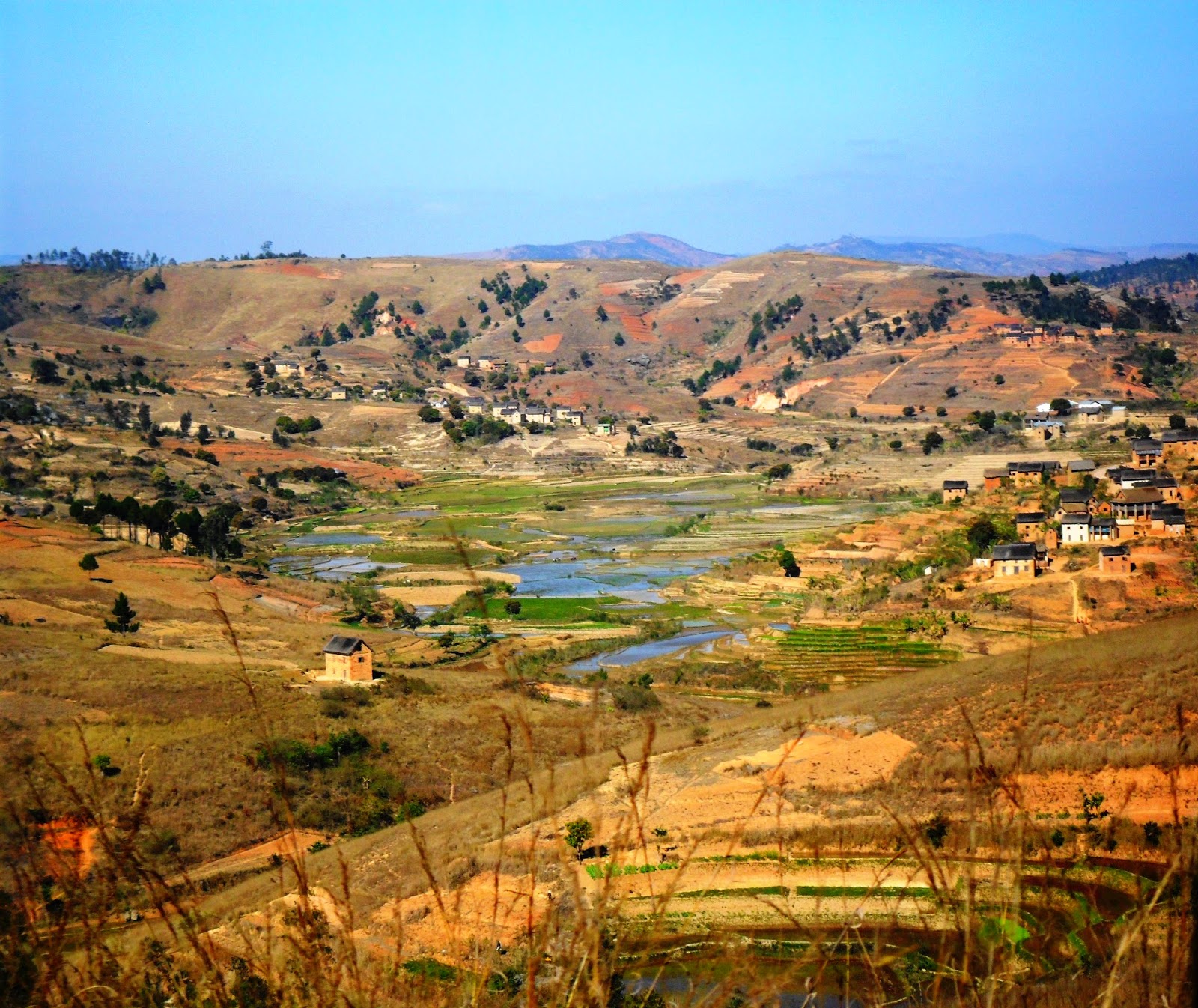
On the way home from a day trip to a neighboring town, I took some pictures of the countryside from the car.  You can see the rice fields and many houses on the hill.

 This is Nomena and I.


 I live in the "Old City" of Fianar, the oldest part of town.  This is a door in that has a map of the old city.  This coming Saturday, the English Club that I help to lead will go on a tour of the old city, so I will have more information about it then.

This is my house.  I also have a bathroom and a closet that you cannot see, and my kitchen is on the porch outside.

 This is the view from my house.  You can see the banana trees and part of the city of Fianar.

 A similar picture, but the view from Nomena's house.

Saturday, September 20, 2014

Hopes

I have been living in Fianarantsoa for over a week now.  I have not started teaching yet, and will not start until October.  So, this first month or so that I am here is about getting settled, working towards knowing the map of the city, knowing which market is good to go too, learning how to cook, and learning to love my new home.  Sure, some days have been harder and some days easier.  But, I find that the day is always better when I force myself to go explore.  That is how I will learn the streets here and begin to be comfortable, even if it involves a lot of getting lost. 

The school that I live at, Masombahoaka, sits almost on the top of a very large hill.  My house is small by American standards, but great for what I need.  My neighbors are all people who teach or work at the school.  One of the families has just part of my Malagasy family, I cooked and at with them the first few days I was here, and on Sunday’s after church for the year.  One of their daughters, Nomena, has helped me to go to the market, cook my dinner, answer all of my, often confusing, questions, and we continue to laugh through it all.  We often cook together, or go on adventures looking for things, and she with her, I helped to kill a chicken.  I did not actually use a knife, I left that to Nomena’s skilled hands, but I held the bird during the cutting and helped to pluck the feathers.  It was an adventure.  Nomena’s mother is Miandry, and there is always much laughter there too.  Like, when Miandry mispronounced “snack” and said that we were eating a snake.  There is also Papa, his name is actually Joseph, but everyone calls him Papa.  He is my site supervisor, but mostly, he is just Papa.  He is full of laughter and jokes as well.  One of the first few things that he said to me when I got off of the taxi-brousse (the bus that runs from town to town) as I arrived in Fianar, and into the taxi that would take us up the giant hill to Masombahoaka, was, “you already stopped for lunch?  Well, in Madagascar you must have two stomachs!”  I learned shortly that this was because there was a second lunch waiting for me when we arrived, but at the time I was very confused. 

I have two more sisters, they are Margot and Elina.  Margot is the self-proclaimed extremely talkative leader of the English club that I will be working with.  English club is a club for youth who want to learn English.  I think they will be mostly between the ages of 14 and 20.  We will have some formal English lessons, but also play games, watch American movies, eat American food, and whatever else we decide will be fun to learn English and about American culture.  Elina is another leader of the English club; she is a student at university in Fianar.  We have adventured together as well, we went to the viewpoint, it is another very tall hill where you can see the whole city of Fianar, and to the lake that is near where I live. 


A few days ago, standing on the deck at Nomena’s house she asked me, “what did you hope Fianar would be like?”  I responded that I hoped that people would be helpful and nice, and that I would have fruit trees in my yard.  I have bananas in my yard, and Nomena’s yard has a mango tree and a peach tree.  So, I have everything that I hoped for.

Saturday, September 6, 2014

Mofo & BonBon Coco


We are comfortable here, relatively. Sure, there are still times when I am walking down the street and there is something that makes me uncomfortable, or when I am attempting to buy something and the seller cannot understand my broken Malagasy, or when we are served full fish for lunch and have to figure out how to take it apart to get the most meat we can. But, compared to when we arrived in Madagascar, we are comfortable here where we have a strong community of people to lean on. But, I know I cannot rely on that community forever. I know that on Tuesday I will wake up and have a squeezed bus ride next to 3 other YAGMs and a Malagasy friend, and then I will head to my placement with people from my host community and it will be me. I will have myself to rely on. Sure, I know that my host community loves me and will do anything they can to help, but that is a very different community than a group of YAGMs who share a culture, language and experiences here. Both of these communities are endlessly valuable, but it is scary to leave the community that I understand.
This Saturday morning we had an experience that both brought these fears to light and reminded me that I am strong and have the skills and knowledge to enter into my host community this coming Tuesday. Our country coordinators sent us on a “culture capture.” We were a short list of things we needed to buy along with a small amount of money and were sent into town independently to find them; then we came back together and explained our experiences. I bought a loaf of Malagasy French bread from a woman selling bread out of large baskets on the street. I knew that I needed to find a baked good, so I had been repeating, “Ohatrinona ny mofo,” in my head as I walked down the street. As I bent down to actually say the sentence aloud, I said in the best pronunciation I could muster, “Hello, how much is the bread?” he responded with a French number said quickly that I couldn’t understand, and when I asked her to say it in Malagasy I finally felt confident. She responded in Malagasy and I found the Ariary in my pocket and bought one load of bread. I continued down the road with bread in hand, knowing that I still needed to find peanuts and to find something that I didn’t know what it was. I checked out multiple peanut stands looking for the best ones. I finally picked some was able to remember to for a cup of peanuts even without remembering the word for peanuts. Walking around for my last item, I had no idea what to pick. But then, I saw the coconut cookies that I made for my family and members of my home church congregation to share about the adventure that I was going to have. I was so excited that the recipe that my mom had found online in July actually existed in Madagascar that I had to have them. I decided that even though I knew what they were, they were going to count as my third item anyway.
I continued back to the center where we are living feeling successful. I know that my communities around the world are never too far away and that I do have the skills and knowledge to live in my new community, all thanks to some baskets of bread and some coconut cookies.

Here is the recipe for the coconut candies that really do exist here in Madagascar.

BonBon Coco
Coconut Candy
2-1/2 C coconut, grated
1 C sugar
1-1/2 C water
Pinch of salt
Combine coconut, sugar and salt in a heavy cooking pot. Add the water; slowly bring to a simmer over medium heat, stirring occasionally. Continue to cook for about twenty minutes, or until coconut mixture is thick and all liquid has evaporated. The coconut will begin to brown; mixture will be stiff and sticky. Remove from heat. Form coconut mixture into balls. Place balls on a sheet of waxed paper; flatten by placing a second sheet of waxed paper on top and pressing down. Set aside to cool completely before removing waxed paper. The balls should be firm but not crunchy. Serve.